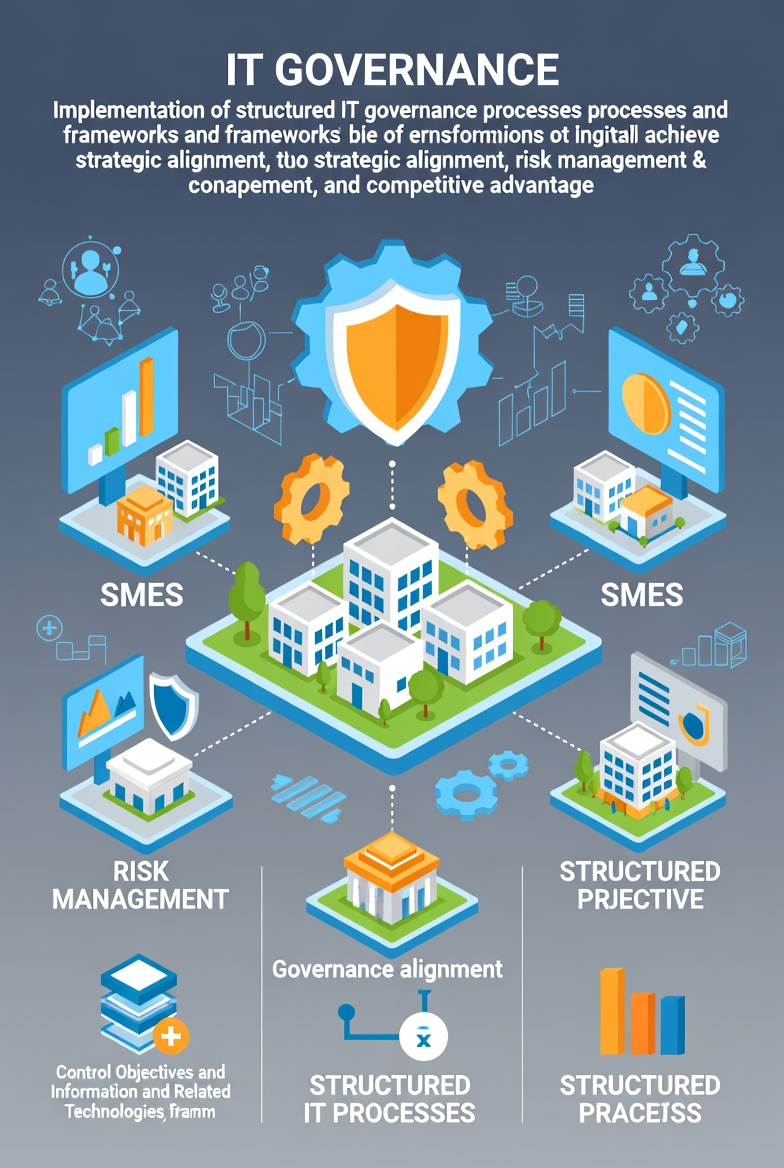

Small and medium-sized enterprises (SMEs) represent over 90% of businesses globally and account for approximately 50% of worldwide employment, according to World Bank data. Yet most operate with weak or nonexistent IT governance—the structures, processes, and accountability mechanisms that align technology with business goals. Only an estimated 15–20% of SMEs implement structured IT governance frameworks. In today’s digital economy, this gap creates severe vulnerabilities.
This assessment examines the multifaceted impacts of poor IT governance in SMEs and proposes pragmatic, scaled solutions tailored to their resource constraints. Analysis of academic literature, industry frameworks (COBIT, ITIL, ISO/IEC 38500), and empirical studies reveals consistent patterns: ungoverned SMEs face higher costs, greater risks, and competitive disadvantages compared to peers with even basic governance practices.
Critical Impacts Across Five Domains
Strategic Effects
Without formal governance, IT investments frequently misalign with business objectives. SMEs lacking structured approaches show roughly 60% lower IT-business alignment. This leads to wasted resources, missed opportunities, and reduced strategic agility—particularly dangerous as emerging technologies like AI, cloud, and IoT reshape markets.
Operational Effects
Ungoverned IT environments suffer from unreliable systems and fragmented processes. Industry benchmarks indicate approximately 40% more unplanned downtime, inconsistent service delivery, and widespread “shadow IT”—unauthorized tools that create integration headaches and security holes. Process efficiency drops by 25–35%, and teams waste significant time on avoidable incidents.
Financial Effects
Poor governance inflates technology costs by 30–40%. Common issues include duplicate software purchases, inefficient licensing, rushed procurement, and weak vendor oversight. Returns on IT investments suffer due to poor project selection and limited measurement of business outcomes, straining already limited SME budgets.
Risk Management Effects
SMEs without governance face 2–3 times more successful cyberattacks. They often lack consistent security policies, regular risk assessments, incident response plans, and staff awareness training. With SMEs comprising about 43% of cyber-attack targets and fewer than 30% holding formal cybersecurity policies, the consequences range from data breaches to operational shutdowns and regulatory penalties.
Competitive Effects
In digitized markets, technology capabilities drive differentiation. Ungoverned SMEs struggle with innovation, showing about 50% lower rates of successful technology adoption. They fall behind in customer experience, scalability, and market responsiveness, creating a widening gap versus better-governed competitors.
Root Causes
These effects stem from structural SME realities: severe resource constraints (financial, human, and technical), knowledge gaps about what governance entails for smaller organizations, and cultural perceptions that view governance as large-enterprise bureaucracy rather than an essential enabler. Owner-managers often prioritize immediate survival over long-term capability building.
Pathways Forward: Tailored IT Governance for SMEs
Effective governance in SMEs must follow five foundational principles:
- Proportionality: (scale to size and risk),
- Pragmatism: (focus on high-impact outcomes),
- Evolutionary design: (grow with the business),
- Integration: (embed in existing processes), and
- Value visibility: (track and communicate benefits).
A practical implementation roadmap aligns with growth stages:
- Startup/Initial: Focus on basic risk management (security policies, backups, simple planning).
- Early Growth: Emphasize operational stability (monitoring, change management, vendor guidelines).
- Mature SME: Advance to performance optimization with metrics and continuous improvement.
Five core components provide the foundation:
- strategic direction setting, 2. clear decision rights, 3. value delivery assurance, 4. risk management processes, and 5. simplified performance measurement.
Key Recommendations for SME Leaders:
- Conduct a quick governance gap assessment using SME-adapted frameworks.
- Start with essential risk controls (security, backups, continuity).
- Build simple alignment processes, such as quarterly IT-business planning.
- Track basic metrics (costs, uptime, value delivered).
- Integrate governance into growth and scaling plans.
- Leverage external expertise or affordable tools where needed.
- Review progress regularly and evolve the approach.
Conclusion
In the digital era, IT governance is no longer optional for SMEs—it determines survival and success. While challenges are real, proportional and pragmatic approaches deliver substantial returns without excessive overhead. By treating governance as a strategic capability rather than bureaucracy, SMEs can reduce risks, control costs, drive innovation, and strengthen their position in competitive markets. The time to act is now.
References
- Ballantine, J., Levy, M., & Powell, P. (1998). Evaluating information systems in small and medium-sized enterprises. European Journal of Information Systems, 7(4), 241–251.
- Bergeron, F., et al. (2017). A framework for research on information technology governance in SMEs. In Strategic IT Governance and Alignment in Business Settings. IGI Global.
- European Commission. (2003). Commission Recommendation 2003/361/EC.
- ISACA. (2025). Five reasons IT governance should not be overlooked. ISACA Now Blog.
- Mijnhardt, F., Baars, T., & Spruit, M. (2016). Organizational characteristics influencing SME information security maturity. Journal of Computer Information Systems, 56(2), 106–115.
- Olutoyin, O., & Flowerday, S. (2016). Successful IT governance in SMEs: An application of the Technology-Organization-Environment theory. South African Journal of Information Management, 18(1), 1–8.
- Pingilili, A., Letsie, N., Nzimande, G., Thango, B., & Matshaka, L. (2025). Guiding IT growth and sustaining performance in SMEs through enterprise architecture and information management. Businesses, 5(2), 17. https://doi.org/10.3390/businesses5020017
- Skrodelis, H., Strebko, J., & Romānovs, A. (2020). The information system security governance tasks in small and medium enterprises. 2020 61st International Scientific Conference on Information Technology and Management Science of Riga Technical University (ITMS).
- Stjepić, A. M., Pejić Bach, M., & Bosilj Vukšić, V. (2021). Exploring risks in the adoption of business intelligence in SMEs using the TOE framework. Journal of Risk and Financial Management, 14(2), 1–18.
- Utomo, D., et al. (2022). Leveraging COBIT 2019 to implement IT governance in SME context. CommIT Journal, 16(2).


No Comments
Leave a comment Cancel